Bennett’s 111 & Loftie-Eaton’s 4-Wicket Over: Zimbabwe, Namibia Seal Semifinals at Africa Regional Final
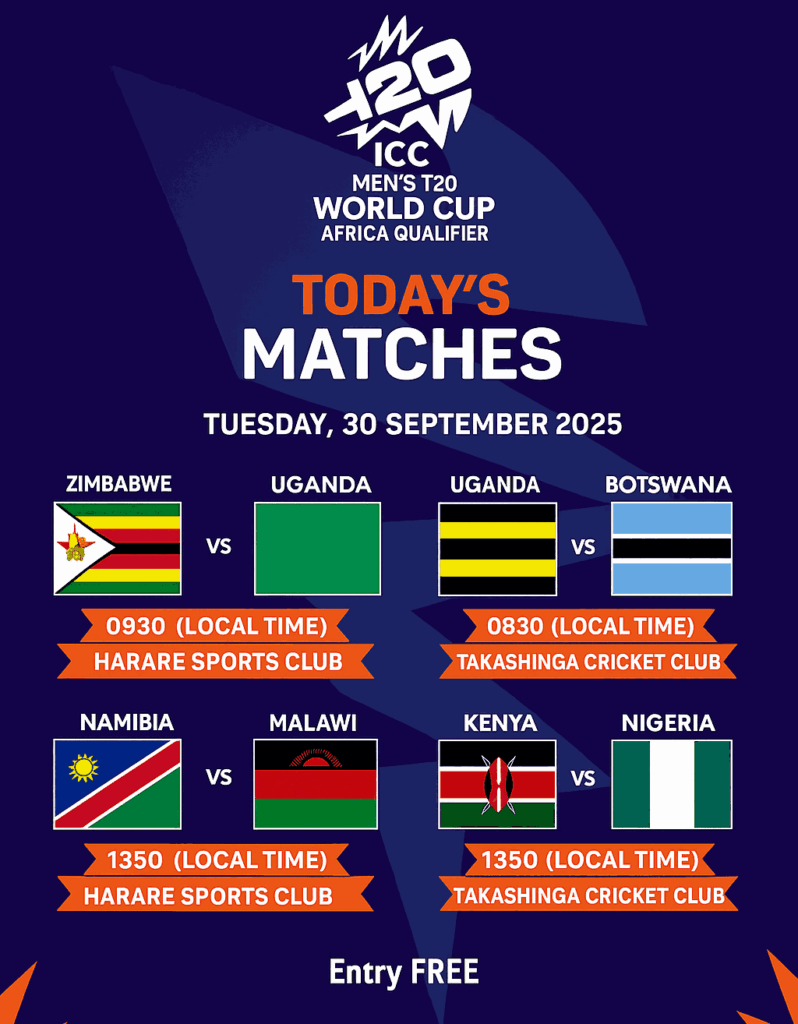
The ICC Men’s T20 World Cup Africa Regional Final delivered four compelling matches on September 30, 2025, as eight nations battled across two Harare venues for precious qualification spots. With Group A and Group B dynamics shifting throughout the day, these crucial encounters directly impact which African teams advance toward qualification for the 2026 global tournament in India and Sri Lanka.
Harare Sports Club and Takashinga Sports Club simultaneously hosted double-headers that produced contrasting results—from Brian Bennett’s explosive century to dominant eight-wicket victories. The tournament structure features two groups of four teams each, with only group winners progressing to the next qualification stage, creating intense pressure for every participating nation.
Tournament Structure and Stakes
The Africa Regional Final operates as a critical gateway toward T20 World Cup 2026 participation, with teams divided into two competitive groups competing in round-robin formats. The tournament’s importance cannot be overstated—only group winners advance to subsequent global qualifying rounds, making every match elimination-level in significance.
Group Standings After September 30 Matches
Group A Final Standings:
| Rank | Team | Played | Won | Lost | NRR | Points |
|---|---|---|---|---|---|---|
| 1 | Namibia ✓ | 3 | 3 | 0 | +6.556 | 6 |
| 2 | Kenya | 3 | 1 | 2 | -1.553 | 2 |
| 3 | Nigeria | 3 | 1 | 2 | -1.822 | 2 |
| 4 | Malawi | 3 | 1 | 2 | -2.613 | 2 |
Group B Standings:
| Rank | Team | Played | Won | Lost | NRR | Points |
|---|---|---|---|---|---|---|
| 1 | Zimbabwe ✓ | 3 | 3 | 0 | +5.262 | 6 |
| 2 | Tanzania | 3 | 2 | 1 | -1.013 | 4 |
| 3 | Uganda | 3 | 1 | 2 | +0.394 | 2 |
| 4 | Botswana | 3 | 0 | 3 | -5.198 | 0 |
Both Namibia and Zimbabwe have secured qualification with perfect 3-0 records, demonstrating superior cricket across all departments while maintaining exceptional net run rates exceeding +5.00.
Match 9: Zimbabwe Crushes Tanzania with Bennett’s Masterclass
Zimbabwe 221/5 (20 overs) defeated Tanzania 108 all out (18.4 overs) by 113 runs
Harare Sports Club witnessed Brian Bennett’s sensational unbeaten 111 off just 60 deliveries as Zimbabwe posted an imposing 221/5 before dismantling Tanzania’s batting lineup to secure a comprehensive 113-run victory.
Bennett’s Century Brilliance
The 25-year-old all-rounder produced a match-winning knock featuring:
- 111 runs from 60 balls at a strike rate of 185.0
- 15 boundaries punishing anything short or overpitched
- 2 maximums clearing the boundary with authority
- Partnership building with Tadiwanashe Marumani (49 off 34) establishing the platform
Bennett’s innings exemplified controlled aggression, accelerating Zimbabwe’s scoring rate throughout his stay at the crease. His dismissal in the 19th over at 201 came too late to affect Zimbabwe’s momentum, with Dion Myers (6* off 10) and Tashinga Musekiwa (4* off 3) finishing unbeaten.
Marumani’s Supporting Role
Wicketkeeper-batsman Tadiwanashe Marumani complemented Bennett perfectly with a 34-ball 49 featuring three fours. The opening partnership of 138 runs consumed just 12.6 overs, effectively ending the contest before Tanzania could establish bowling momentum. Marumani’s dismissal—leg before wicket to Laksh Bakrania—provided Tanzania’s first breakthrough, but the damage was irreparable.
Sikandar Raza’s Brief Contribution
Captain Sikandar Raza managed 19 runs from nine deliveries before Ally Kimote dismissed him. Ryan Burl added 22 off 11 balls before becoming Khalidy Juma’s second victim. These cameo contributions maintained Zimbabwe’s aggressive approach despite wickets falling regularly in the final overs.
Tanzania’s Bowling Struggles
Tanzania’s bowling attack faced relentless pressure throughout Zimbabwe’s innings:
- Khalidy Juma: 4-0-39-2 (economy rate 9.75)
- Ally Kimote: 4-0-42-2 (economy rate 10.50)
- Laksh Bakrania: 2-0-35-1 (economy rate 17.50)
- Sivaraj Selvaraj: 4-0-40-0 (economy rate 10.00)
The absence of economical bowling options allowed Zimbabwe’s batsmen to score freely, with no bowler achieving containment despite wicket-taking success for some.
Tanzania’s Batting Collapse
Chasing 222 required extraordinary batting, but Tanzania collapsed comprehensively for just 108 in 18.4 overs. Only three batsmen reached double figures:
- Abhik Patwa: 32 off 22 balls (top score)
- Kassim Nassoro: 25 off 27 deliveries
- Sivaraj Selvaraj: 20 off 18 balls
The innings featured numerous single-digit scores, with opener Arun Yadav dismissed for 4 and wicketkeeper Amal Rajeevan scoring a golden duck. The middle order offered minimal resistance against Zimbabwe’s disciplined bowling attack.
Zimbabwe’s Bowling Excellence
Brad Evans delivered a devastating spell, claiming 4-16 from four overs with an economy rate of 4.00. His wickets included key middle-order batsmen, preventing any recovery partnership. Richard Ngarava (3-0-13-2) and Sikandar Raza (2-0-6-2) provided excellent support, maintaining pressure throughout Tanzania’s innings.
The comprehensive nature of this victory—113 runs representing Zimbabwe’s dominance—solidified their group leadership while simultaneously damaging Tanzania’s net run rate despite their 2-1 record.
Match 10: Uganda Defeats Botswana in Low-Scoring Encounter
Botswana 81/6 (20 overs) lost to Uganda 85/2 (12.4 overs) by 8 wickets
Takashinga Sports Club hosted a contrasting encounter where Botswana’s batting struggles produced a mere 81/6 in their full allocation before Uganda comfortably chased the target in just 12.4 overs with eight wickets remaining.
Botswana’s Batting Woes
Botswana’s innings never gained momentum, with regular wickets preventing partnership building:
- Vinoo Balakrishnan: 24 off 22 balls (top score)
- Monroux Kasselman: 20 off 38 deliveries
- Reginald Nehonde: 16* off 25 balls (unbeaten)
The remaining batsmen contributed minimal runs, with extras (4) matching several individual scores. The inability to accelerate or build substantial partnerships reflected Botswana’s struggles throughout the tournament.
Uganda’s Disciplined Bowling
Uganda’s bowling attack shared wickets evenly, maintaining exceptional economy rates:
- Riazat Ali Shah: 2-0-7-2 (economy 3.50)
- Dinesh Nakrani: 4-0-13-2 (economy 3.25)
- Henry Ssenyondo: 4-0-12-1 (economy 3.00)
- Alpesh Ramjani: 4-0-14-1 (economy 3.50)
This collective bowling excellence restricted Botswana to the tournament’s lowest total on September 30, creating a straightforward chase for Uganda’s batsmen.
Dhawan’s Match-Winning Knock
Raghav Dhawan anchored Uganda’s successful chase with an unbeaten 54 off 45 balls, striking at 120.00. His innings featured four boundaries and controlled aggression, ensuring Uganda never faced pressure despite early wickets.
Sumeet Verma provided crucial support with 29* off 30 deliveries, including a solitary six. Their unbroken partnership guided Uganda home with 7.2 overs remaining, showcasing the target’s inadequacy against competent batting.
Early Setbacks Overcome
Uganda lost both openers cheaply—Ronald Lutaaya run out for a duck and Robinson Obuya dismissed LBW by Boemo Kgosiemang for 0—creating momentary tension at 2/2. However, Dhawan and Verma’s partnership eliminated any victory doubts, demonstrating maturity under pressure.
The eight-wicket victory margin understated Uganda’s dominance, with the chase completed effortlessly despite the shaky start.
Match 11: Namibia Secures Group A Victory Over Malawi
Malawi 71 all out (16.2 overs) lost to Namibia 72/2 (7.5 overs) by 8 wickets
Namibia completed a perfect group stage with their third consecutive victory, demolishing Malawi for 71 before chasing the target in less than eight overs at Harare Sports Club.
Loftie-Eaton’s Devastating Spell
Jan Nicol Loftie-Eaton produced the tournament’s most remarkable bowling performance on September 30, claiming 4-10 from four overs with an economy rate of just 2.50. His spell included four consecutive wickets:
- Moazzam Baig (6 runs)
- Muhammad Kazim Somani (0 runs)
- Suhail Vayani (0 runs)
- Mike Choamba (0 runs)
This devastating sequence—four wickets across six deliveries spanning the sixth over—effectively ended Malawi’s innings before reaching the halfway mark. Loftie-Eaton’s accuracy and variations proved unplayable for Malawi’s middle order.
Malawi’s Batting Disintegration
Only wicketkeeper Gift Kansonkho offered substantial resistance, remaining unbeaten on 31 off 31 balls. The remainder of Malawi’s batting lineup collapsed spectacularly:
- Sami Sohail: 11 off 16 balls (second-highest score)
- Bright Balala: 7 off 26 deliveries
- Daniel Jakiel: 6 off 5 balls
Six batsmen scored between 0-6 runs, illustrating Namibia’s bowling dominance. The total of 71 represented the second-lowest score of the day, eliminating any realistic defensive prospects.
Namibia’s Comprehensive Bowling Attack
Beyond Loftie-Eaton’s brilliance, Namibia’s bowling unit maintained collective excellence:
- JJ Smit: 3-0-10-3 (economy 3.33)
- Ben Shikongo: 3-0-14-1 (economy 4.67)
- Ruben Trumpelmann: 3-0-16-1 (economy 5.33)
This balanced attack provided captain Gerhard Erasmus with multiple wicket-taking options, preventing Malawi from settling against any particular bowler.
Clinical Chase Led by Kruger and Frylinck
Malan Kruger (28 off 11 balls) and Jan Frylinck (22* off 18) guided Namibia toward victory with minimal difficulty. Kruger’s aggressive approach—striking at 254.55 with four boundaries and two sixes—accelerated the chase before Sami Sohail dismissed him.
Louren Steenkamp contributed 7 runs before becoming Sohail’s second victim, but Jan Nicol Loftie-Eaton (14* off 10) joined Frylinck to complete the formalities. The victory margin—eight wickets with 12.1 overs unused—demonstrated Namibia’s comprehensive superiority.
Perfect Group Stage Record
This third consecutive victory confirmed Namibia’s Group A championship with a flawless 3-0 record and exceptional +6.556 net run rate. Their balanced team performance across batting, bowling, and fielding departments positions them as serious contenders in subsequent qualification rounds.
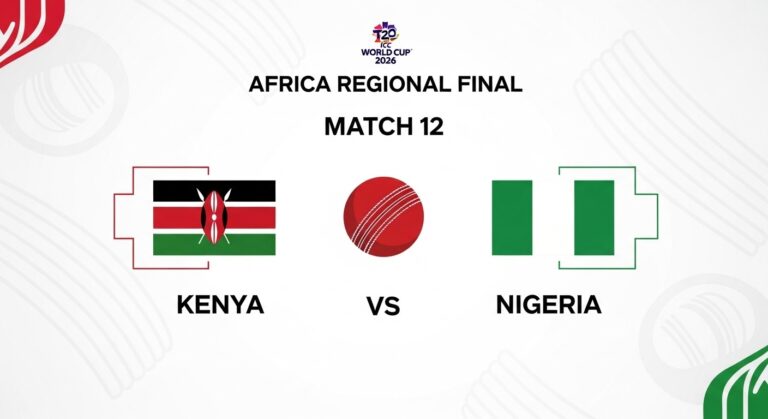
Match 12: Kenya Defeats Nigeria to Keep Hopes Alive
Nigeria 147/7 (20 overs) lost to Kenya 148/3 (13.4 overs) by 7 wickets
Kenya kept their tournament hopes alive with a convincing seven-wicket victory over Nigeria at Takashinga Sports Club, chasing 148 with 6.2 overs remaining.
Danladi’s Fighting Innings
Isaac Danladi top-scored for Nigeria with 53 runs off 47 deliveries, striking at 112.77. His innings featured seven boundaries and one maximum, providing Nigeria’s batting with necessary substance. Danladi’s dismissal in the 17th over by Nitish Hirani ended Nigeria’s best partnership and most productive phase.
Nigeria’s Middle-Order Contributions
Captain Sylvester Okpe added 26 off 19 balls with a strike rate exceeding 136, while opener Sulaimon Runsewe contributed 27 off 32 deliveries. Prosper Useni’s 13-run cameo maintained momentum during the middle overs. However, the absence of a substantial second-innings partnership limited Nigeria’s total.
Kenya’s Bowling Discipline
Kenya’s bowling attack shared wickets evenly without any bowler dominating:
- Vraj Patel: 4-0-29-2 (economy 7.25)
- Lucas Ndandason: 3-0-15-2 (economy 5.00)
- Nitish Hirani: 3-0-21-1 (economy 7.00)
- Jasraj Kundi: 2-0-15-1 (economy 7.50)
The collective effort restricted Nigeria to a manageable total despite individual contributions from multiple batsmen.
Patel and Bhudia’s Match-Winning Partnership
Rakep Patel (53 off 38 balls) and Sachin Bhudia (57* off 29) constructed the tournament’s most dominant partnership on September 30, adding 102 runs together. Their contrasting approaches complemented perfectly:
Rakep Patel’s Innings:
- 53 runs from 38 deliveries
- Strike rate of 139.47
- Five boundaries and two sixes
- Anchored chase through middle overs
Sachin Bhudia’s Explosion:
- 57 runs from just 29 balls (unbeaten)
- Extraordinary strike rate of 196.55
- Four fours and four maximums
- Accelerated chase in final stages
Bhudia’s incredible striking transformed a comfortable chase into a commanding victory, with his unbeaten fifty ensuring Kenya crossed the line with overs to spare.
Early Wickets Create Brief Tension
Kenya lost captain Dhiren Gondaria (12 off 8) and Pushkar Sharma (15 off 10) within the first four overs, momentarily suggesting pressure. However, Patel and Bhudia’s partnership eliminated all doubt, with their aggressive batting rendering Nigeria’s bowling attack ineffective.
Tournament Implications
Despite this victory, Kenya finished second in Group A behind Namibia due to inferior net run rate (-1.553 compared to Namibia’s +6.556). Nigeria’s defeat confirmed their elimination despite also finishing with a 1-2 record, with their -1.822 NRR proving decisive.
Key Tournament Takeaways
Dominant Group Winners
Both Zimbabwe and Namibia finished with identical 3-0 records and exceptional net run rates exceeding +5.00, suggesting these nations possess significantly superior resources compared to regional competitors. Their comprehensive victories across all matches indicate strong depth in both batting and bowling departments.
Batting Performances of Note
Several individual innings defined September 30’s action:
- Brian Bennett (Zimbabwe): 111 off 60 balls—the day’s standout performance
- Sachin Bhudia (Kenya): 57* off 29 at strike rate 196.55
- Raghav Dhawan (Uganda): 54* off 45 guiding successful chase
- Isaac Danladi (Nigeria): 53 off 47 in losing effort
- Rakep Patel (Kenya): 53 off 38 anchoring partnership
These innings demonstrated varying approaches—Bennett’s controlled aggression, Bhudia’s explosive power, Dhawan’s anchor role, and Danladi’s fighting spirit in adversity.
Bowling Excellence
Outstanding bowling spells shaped match outcomes decisively:
- Jan Nicol Loftie-Eaton (Namibia): 4-10 from 4 overs (economy 2.50)
- Brad Evans (Zimbabwe): 4-16 from 4 overs (economy 4.00)
- Uganda’s collective effort: Four bowlers with economy rates below 3.75
These performances highlighted the importance of disciplined bowling in T20 cricket, particularly when defending modest totals or creating pressure on chasing teams.
Net Run Rate Significance
The tournament’s final standings emphasized net run rate’s critical importance in round-robin competitions. Kenya, Nigeria, and Malawi all finished with identical 1-2 records in Group A, but varying margins of victory and defeat determined their final positions. Similarly, Tanzania’s superior NRR (+1.013 versus Uganda’s +0.394) secured second place in Group B despite identical records.
Qualification Pathway Forward
Zimbabwe and Namibia now advance to the next stage of T20 World Cup 2026 qualification, joining other regional winners in global qualifying tournaments. The path forward involves:
Regional Integration Stage
African qualifiers typically merge with European or Asian-Pacific qualifiers in subsequent rounds, creating geographically diverse competitions. This integration tests teams against varied playing styles and conditions, preparing successful qualifiers for the World Cup environment.
Global Qualifier Tournament
The penultimate stage before World Cup participation features regional qualifier winners competing for remaining tournament spots. Historical precedents suggest 2-4 qualification positions available, creating intense competition among approximately 12-16 participating nations.
Host Nation Advantage
With the 2026 T20 World Cup scheduled for India and Sri Lanka, subcontinental conditions favor teams with experience in similar environments. Zimbabwe and Namibia must prepare for spin-friendly pitches, high humidity, and passionate crowds significantly different from African conditions.
Venue Performance Analysis
Harare Sports Club
The primary venue hosted Zimbabwe’s dominant victory over Tanzania and Namibia’s clinical performance against Malawi. The ground’s excellent batting surface produced the day’s highest total (221/5) while also witnessing comprehensive bowling performances. The venue’s consistent bounce and true carry rewarded both aggressive batting and disciplined bowling.
Takashinga Sports Club
The secondary venue produced lower-scoring encounters, with Uganda defending 85 successfully and Kenya chasing 148 comfortably. The pitch characteristics appeared slower, favoring bowlers who maintained tight lines and utilized variations effectively. Neither match produced totals exceeding 150, suggesting conditions differed significantly from Harare Sports Club.
Historical Context and Regional Cricket Development
Zimbabwe’s Regional Dominance
Zimbabwe’s perfect group stage record continues their historical dominance in African cricket. As a former Test-playing nation with established domestic structures, their superior resources and experience manifest consistently in regional competitions. The challenge remains translating regional success into global competitiveness.
Namibia’s Rising Standards
Namibia’s emergence as consistent regional champions reflects sustained investment in cricket infrastructure and player development. Their participation in recent ICC global tournaments has provided invaluable experience, creating competitive advantages over emerging African nations still building cricket systems.
Development Nation Progress
Tanzania’s 2-1 record and Uganda’s competitive performances indicate improving standards among African associate members. While still inferior to Zimbabwe and Namibia, these nations demonstrate gradual progress in player quality, coaching expertise, and competitive experience. Continued exposure to high-level competition will accelerate their development trajectories.
Frequently Asked Questions
Which teams qualified from the ICC Men’s T20 World Cup Africa Regional Final?
Zimbabwe and Namibia qualified as Group B and Group A winners respectively, both finishing with perfect 3-0 records and exceptional net run rates exceeding +5.00.
What was the highest individual score on September 30?
Brian Bennett’s unbeaten 111 off 60 balls for Zimbabwe against Tanzania represented the day’s highest individual innings and included 15 fours and 2 sixes.
Which bowler had the best figures during the matches?
Jan Nicol Loftie-Eaton of Namibia claimed 4-10 from 4 overs against Malawi, including four wickets across six deliveries in a devastating spell.
What were the venues for these matches?
Harare Sports Club and Takashinga Sports Club in Harare, Zimbabwe, simultaneously hosted double-header matches starting at 12:30 PM and 4:50 PM local time.
How does net run rate affect final standings?
Teams with identical records are separated by net run rate, calculated from runs scored versus runs conceded per over. Kenya, Nigeria, and Malawi all finished 1-2 in Group A but were ranked by NRR.
What happens to teams that didn’t qualify?
Non-qualifying teams (Kenya, Nigeria, Malawi, Tanzania, Uganda, Botswana) return to domestic cricket and future regional competitions, using this experience for development purposes.
When will Zimbabwe and Namibia play their next qualification matches?
Specific dates for subsequent qualification rounds haven’t been announced, but typically occur within 3-6 months of regional finals, allowing preparation time.
What was the lowest team total on September 30?
Malawi’s 71 all out in 16.2 overs against Namibia represented the day’s lowest total, followed closely by Botswana’s 81/6 in 20 overs against Uganda.
Which match had the largest victory margin?
Zimbabwe’s 113-run victory over Tanzania represented the most dominant performance, combining the day’s highest total (221/5) with comprehensive bowling to dismiss Tanzania for 108.
How many teams participate in the Africa Regional Final?
Eight teams competed across two groups of four: Group A (Namibia, Kenya, Nigeria, Malawi) and Group B (Zimbabwe, Tanzania, Uganda, Botswana).
Conclusion
September 30, 2025, delivered compelling cricket action across four matches that determined the ICC Men’s T20 World Cup Africa Regional Final outcomes. Zimbabwe and Namibia’s dominant performances throughout the tournament—culminating in perfect 3-0 group stage records—confirmed their status as African cricket’s elite nations while highlighting the development gap with emerging competitors.
Brian Bennett’s sensational century, Jan Nicol Loftie-Eaton’s devastating bowling spell, and Sachin Bhudia’s explosive finishing demonstrated individual brilliance within team-oriented frameworks. These performances, combined with comprehensive team efforts from qualification winners, provided entertainment while advancing continental cricket toward global representation.
The qualified nations now focus on subsequent qualification rounds, where success requires adaptation to different conditions, opponents, and pressure situations. For non-qualifying teams, this tournament provides valuable competitive experience and identifies areas requiring development investment. African cricket’s continued growth depends on sustained progress from development nations gradually closing the quality gap with established powers.
As the qualification pathway progresses toward the 2026 T20 World Cup in India and Sri Lanka, Zimbabwe and Namibia carry African cricket’s hopes for global tournament success, representing a continent with immense potential awaiting fuller realization through continued investment and competitive opportunities.